
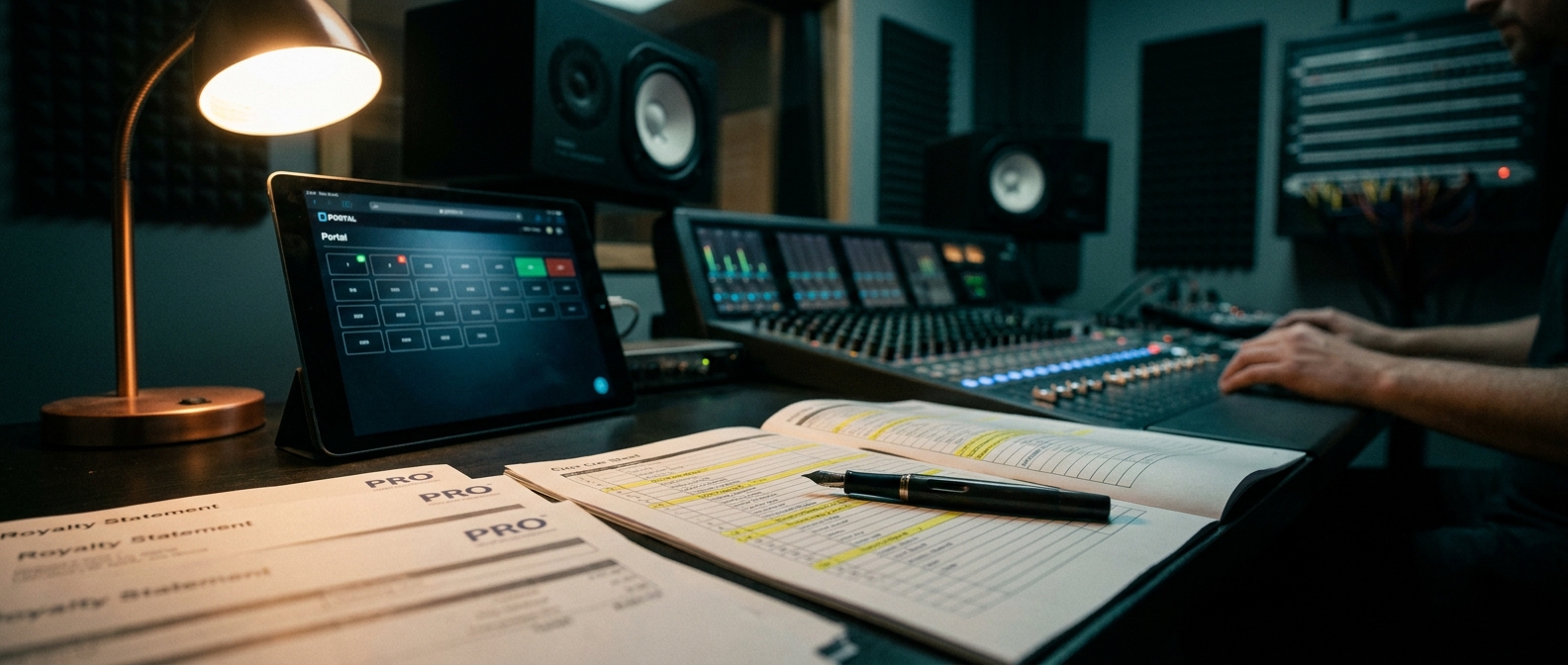
The license fee is not the royalty
Most buyers walk in thinking the number on the license is the whole transaction. It is not, and the gap is the single most misread part of how music royalties work. The license fee buys you permission to sync a cue to your picture. Royalties are a separate, ongoing stream that the music itself generates after it airs, paid by broadcasters and platforms, collected by societies, and distributed to the people who wrote and own the work.
Those two flows never touch your invoice as a buyer. You pay the sync fee once. The royalty machinery runs in the background between the broadcaster and the rights holders, on a schedule and a math you are not part of. Understanding that separation is what keeps you from either double-paying out of caution or assuming a cheap license has hidden meters attached to it.
The royalty model in plain terms
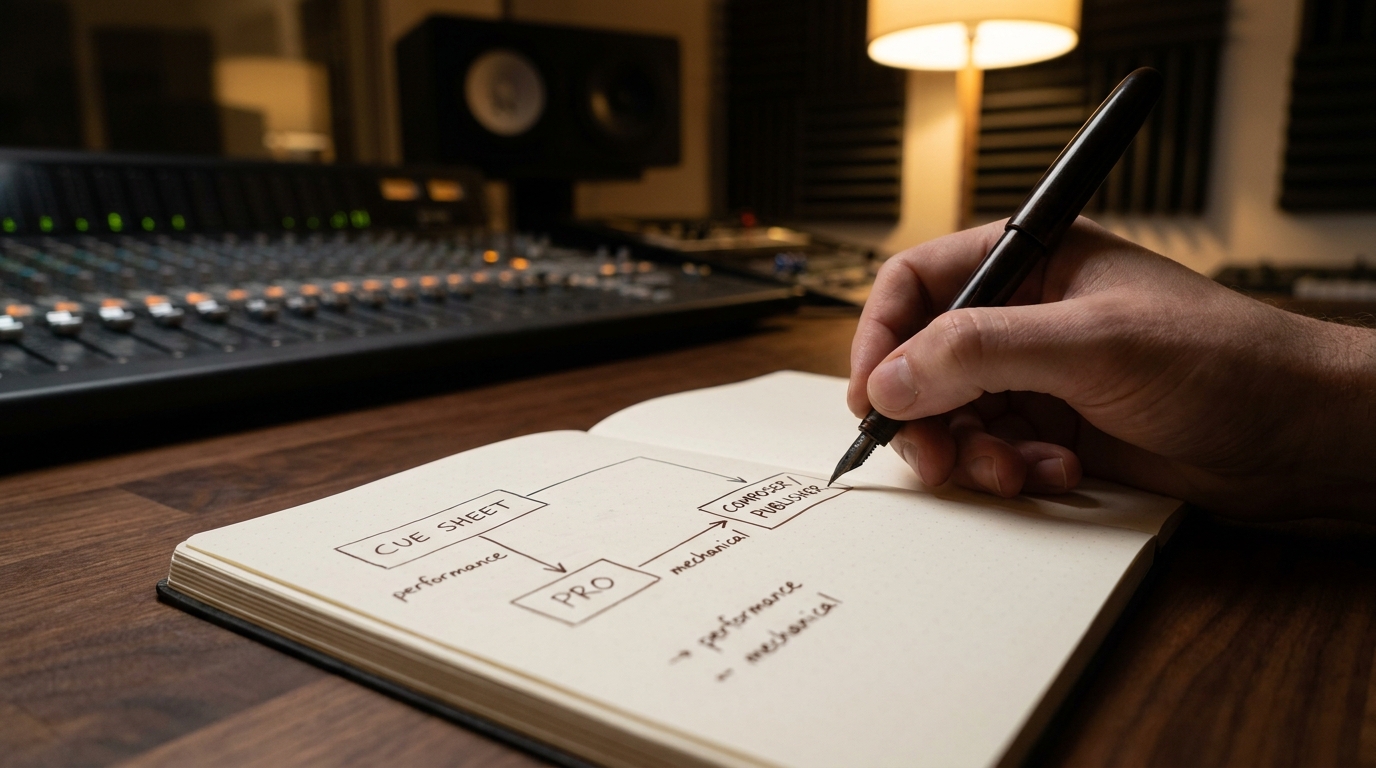
A royalty is money owed every time a piece of music is used in a way the law reserves to the copyright holder. For production music the two that matter are performance royalties and mechanical royalties. They attach to the same cue but they are triggered by different acts, and they are collected by different organizations. Conflate them and the accounting stops making sense fast.
Performance royalties
A performance royalty is generated when music is communicated to the public: broadcast on television, streamed, played on radio, run in a venue. The act being paid for is the public performance of the composition. When your cleared cue airs inside a national spot, that broadcast is a performance, and the broadcaster, not you, owes a performance royalty on it.
Mechanical royalties
A mechanical royalty is generated when a composition is reproduced into copies: pressed to disc, sold as a download, or reproduced inside a distributed program. In the production music world mechanicals are smaller and more situational than performance income, but they exist, and on certain reproductions and physical or downloadable product they are owed to the publisher and writer of the composition.
Who collects, and who pays
Royalties do not move directly from a broadcaster to a songwriter. They move through collection societies built for exactly this, because no writer could invoice every station and platform that ran their work. There are two kinds of society, one per royalty type, and knowing which is which clears up most of the confusion buyers carry.
- Performing rights organizations (PROs) collect performance royalties. In the US these are ASCAP, BMI, and SESAC. Broadcasters and platforms pay them blanket and per-program fees, and the PRO distributes to its registered writers and publishers based on cue sheets and usage data.
- Mechanical rights organizations (MROs) handle mechanical royalties. The Harry Fox Agency is the long-standing US mechanical licensing intermediary, and on the streaming side the Mechanical Licensing Collective administers the statutory blanket license.
The fuel that makes the performance side work is the cue sheet: a log of exactly which cues ran, for how long, in what program. A production submits the cue sheet, the broadcaster files it, and the PRO uses it to match payments to the right writers. No cue sheet, no clean distribution, which is one reason a library that registers its catalog properly matters more than it looks.
People hear PRO and assume a bill is coming for them. It is the opposite. The station is paying the society. The buyer who cleared the cue is already done.
Production music and the PROs
Production music sits inside this same royalty system, just with the ownership simplified. Every cue in a production library is registered with a PRO under the library's writers and its publishing affiliate, so when the cue performs publicly, the performance royalty flows back through ASCAP, BMI, or SESAC to those parties. That stream is theirs by design and is wholly separate from the fee you paid to license the cue.
This is where the model is genuinely cleaner than clearing a commercial release. With a famous track you are negotiating a sync fee with a label and a publisher who each also expect their slice of downstream royalties, across a chain of co-writers. With production music the master and publishing are held at the source, the writers are known, the registrations are already filed, and the performance income routes itself.
What buyers actually pay versus what gets distributed
Put the two flows side by side and the buyer's side gets short. You pay one sync license fee for the cue and the use. That clears the music against your picture, cleared in perpetuity for broadcast, streaming, social, theatrical, out-of-home, and internal, with no renewal and no scope upcharge. That single payment is your entire obligation.
The distribution side is longer, but it runs without you. Broadcasters and platforms pay their blanket fees to the PROs. The cue sheets get filed. The societies distribute performance royalties to the library's writers and publisher, and any mechanicals route through the MROs. None of that touches your budget after the license is signed, which is exactly the predictability brands and agencies on a calendar are buying.
- Buyer pays the flat sync license fee, once, for the cue and the defined use.
- Buyer receives the full mix, stems, and the 60/30/15/stinger/loop edit set, same-day on confirmation.
- The cue airs, and the broadcaster or platform pays performance royalties to the PRO under its existing blanket agreements.
- The PRO distributes that performance income to the library's registered writers and publisher, with no further bill to the buyer.