
Why you need a checklist, not a vibe
Picking a production music library on the strength of the catalog you can hear is a mistake. The audio is the easy part to judge and the least likely to hurt you. What hurts you is the paperwork you cannot hear: a term that lapses on a campaign you forgot was still running, a scope that covered broadcast but not the social cutdown, a stem package that turns out to be an upsell once you are already committed.
The best production music library for your work is not the one with the prettiest reel. It is the one whose answers to a short list of blunt questions hold up under a deadline and under a legal review. So before you bookmark anything, learn how to choose a music library by interrogating it the way your rights team eventually will, except do it now, while switching still costs nothing.
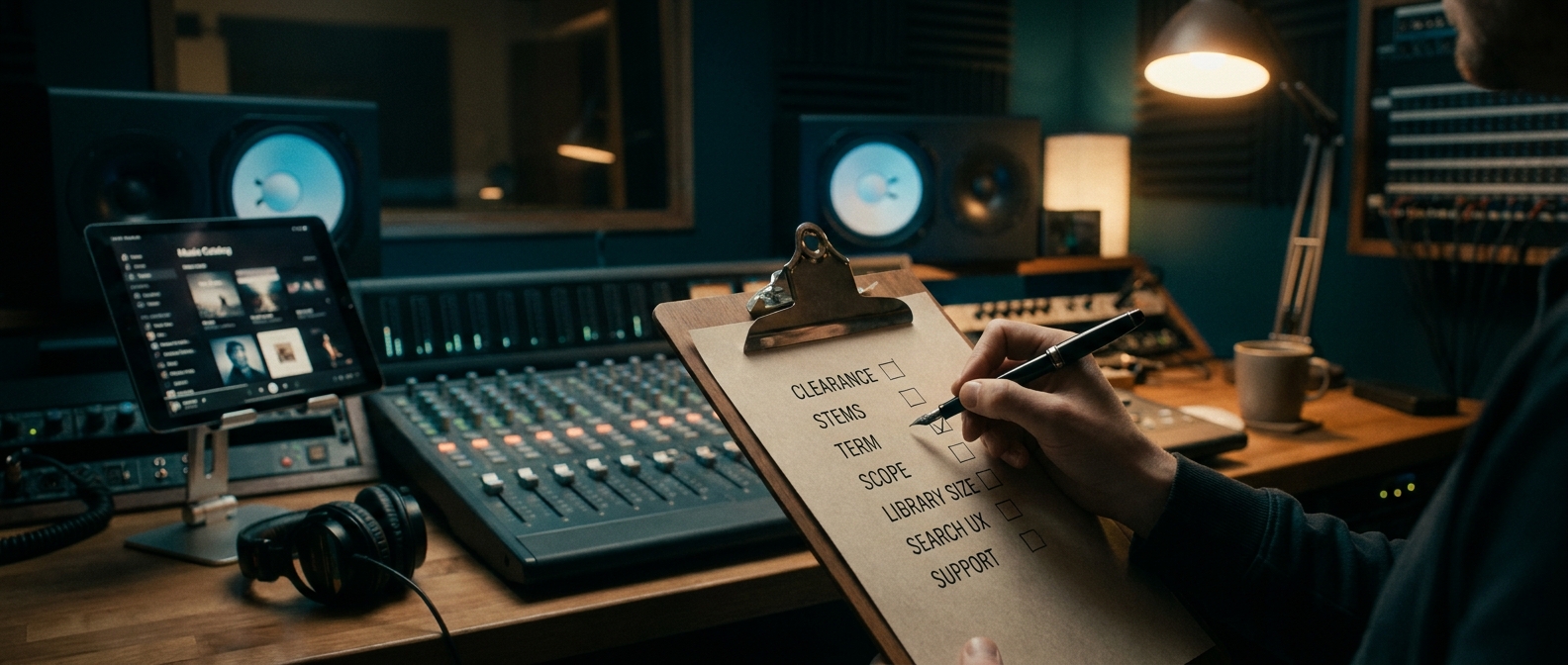
The seven questions to ask any library
Work through these in order. The first two are disqualifying on their own: if a library fumbles clearance posture or treats stems as a luxury, the rest of the list barely matters.
- Clearance posture. Who holds the rights, and is the publishing held alongside the master, or only the recording? A library that controls one layer and points you at a third party for the other has handed you a chain to clear, not a license.
- Stems as standard. Do multitrack stems ship with the cue, or are they a request, a tier, or a separate invoice? Edit rooms need to pull elements down and push hits up. If stems are gated, your post team finds out at the worst possible moment.
- Term. Is the license in perpetuity, or does it expire after one, three, or five years? Term-limited rights are a recurring bill disguised as a discount, and they are lethal on evergreen content.
- Scope. Which media are covered, and is paid use included? You want broadcast, streaming, social, theatrical, out-of-home, and internal in a single grant, not a menu where each platform is its own upcharge.
- Library size and depth. Sixty thousand cues is only useful if the catalog goes deep inside the genres you actually license. Ask for the count and then ask how many sit in your three most-used moods.
- Search and audition experience. Can you filter by mood, tempo, and instrumentation and audition fast, or are you scrolling a flat list? Bad search quietly adds a day to every project.
- Support and turnaround. When a brief is messy or a cut is due tomorrow, is there a human who answers, and how fast do files land after you confirm?
Notice that only two of the seven are about the music itself. That is deliberate. Catalogs converge on quality faster than they converge on terms, and the terms are what survive contact with your legal team.
Red flags that should end the conversation
Some answers are not yellow lights to negotiate around. They are reasons to close the tab. If you hear any of the following, the cost of the library is not the sticker price, it is the claim, the takedown, or the re-clearance you will be paying later.
Vague clearance language
If a library cannot tell you in plain words who holds the publishing, or describes tracks as cleared without specifying both layers, assume the gap is real. A song carries two copyrights. A library that only owns one of them is selling you half a clearance, which clears nothing when a publisher's claim arrives.
Scope sold as add-ons
Watch for the rate card that quotes a low base and then prices broadcast, social, and a second territory as upgrades. Each line is a separate negotiation, and the number you were shown is rarely the number you pay. The same trap hides in term: a cheap one-year license that renews into your budget every year the content stays live.
What to ask for in a trial brief
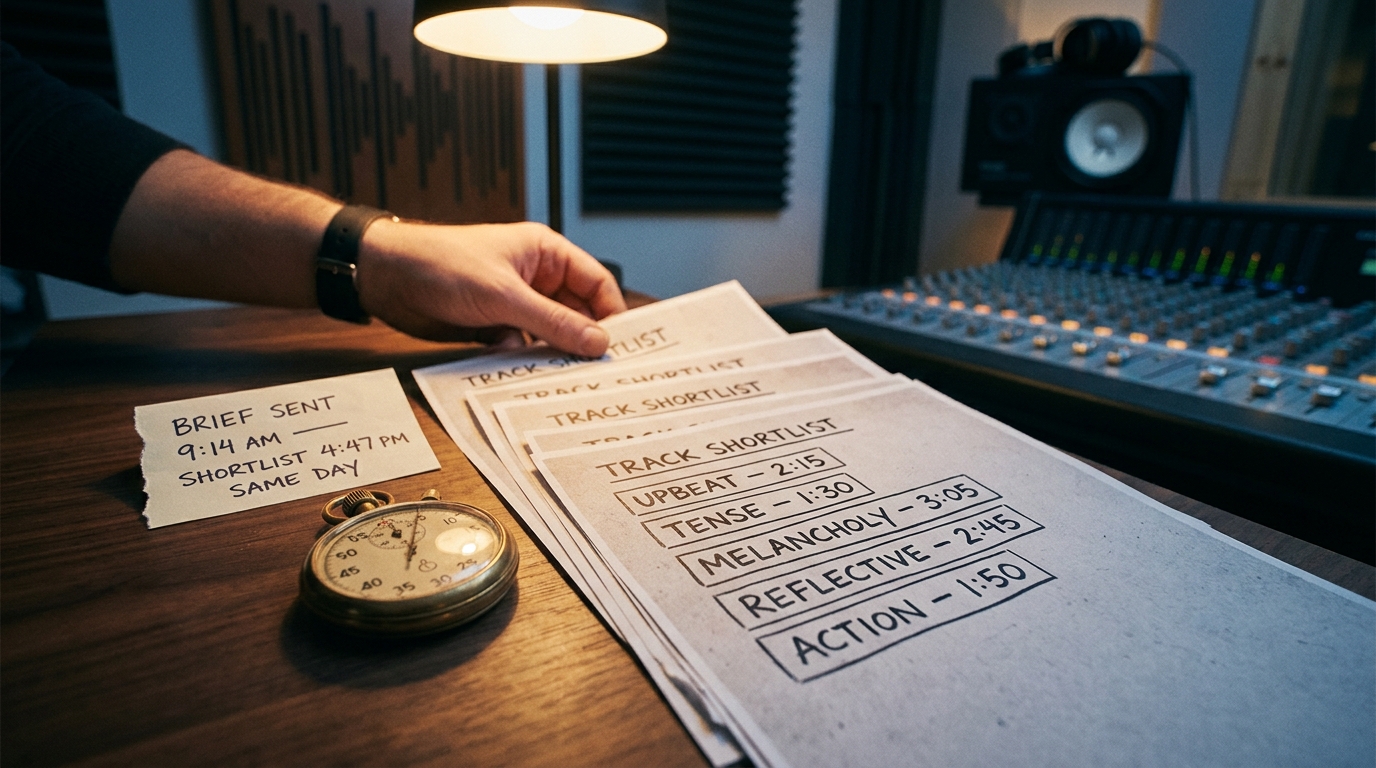
Reels are curated. The way to see how a library actually performs is to hand it a real brief and watch what comes back, and how fast. You learn more from one honest turnaround than from an hour of browsing.
- Send the messy version. Give them your real reference, your real deadline, and your real awkward constraint, the one you would normally smooth over. A good library asks a sharp follow-up. A weak one sends a generic shortlist.
- Time the response. Note when the curated shortlist lands. One business day on a brief is a working pace. A week is a signal about every future deadline.
- Request a watermarked WAV and the full license terms together. If you can audition against your cut and read the exact scope in the same sitting, the library is built for buyers.
- Audition against the cut. Drop the watermarked WAV under your actual edit and see how the cue sits with dialogue and picture. A shortlist that holds up under the cut is the only one that matters.
Pricing structures, explained
Three pricing models dominate this market, and they fail buyers in different ways. Knowing which one you are looking at is half of how to choose a music library without a surprise on the second invoice.
Subscription and royalty-free
Low monthly cost, broad-looking access, and a license that often quietly expires when your plan does. Fine for organic social and internal cuts. Dangerous on a paid national spot, where the rights you stop paying for are the rights you stop holding.
Per-track, scope-priced
The traditional library model. Each cue is priced against term, territory, and media, so the figure moves every time the campaign grows. Predictable only if your scope never changes, which it always does.
Flat-scope, single-source
One party holds both rights and writes a fixed scope, so the number is knowable before you commit. The premium over royalty-free buys the thing royalty-free cannot: a clearance that does not unravel when the work succeeds.
What GMP's answers look like
We built this checklist out of the questions buyers actually put to us, so it is fair to answer it on the record. Run GMP through the seven and here is what comes back.
- Clearance posture: master and publishing held at the source on every cue. One license clears both layers, so your legal review is one signature, not a chain.
- Stems: standard with every track, no request and no upcharge. Pre-built 60/30/15/stinger/loop durations ship alongside the full mix.
- Term and scope: worldwide rights, all media, in perpetuity by default. Broadcast, streaming, social, theatrical, out-of-home, and internal are inside the same grant, with no renewal and no scope upsell.
- Depth and support: sixty thousand cleared, broadcast-ready cues in continuous operation since 1986, with same-day delivery on confirmation and a one-business-day turnaround on curated shortlists.
You do not have to take that on faith, and you should not. The whole point of the checklist is that it works on any library, including this one. Send a brief, read the license, time the response, and compare. A working alternative to royalty-free, stock, and direct-with-label deals should be able to answer cold, and stand by the answer when the work goes live.