
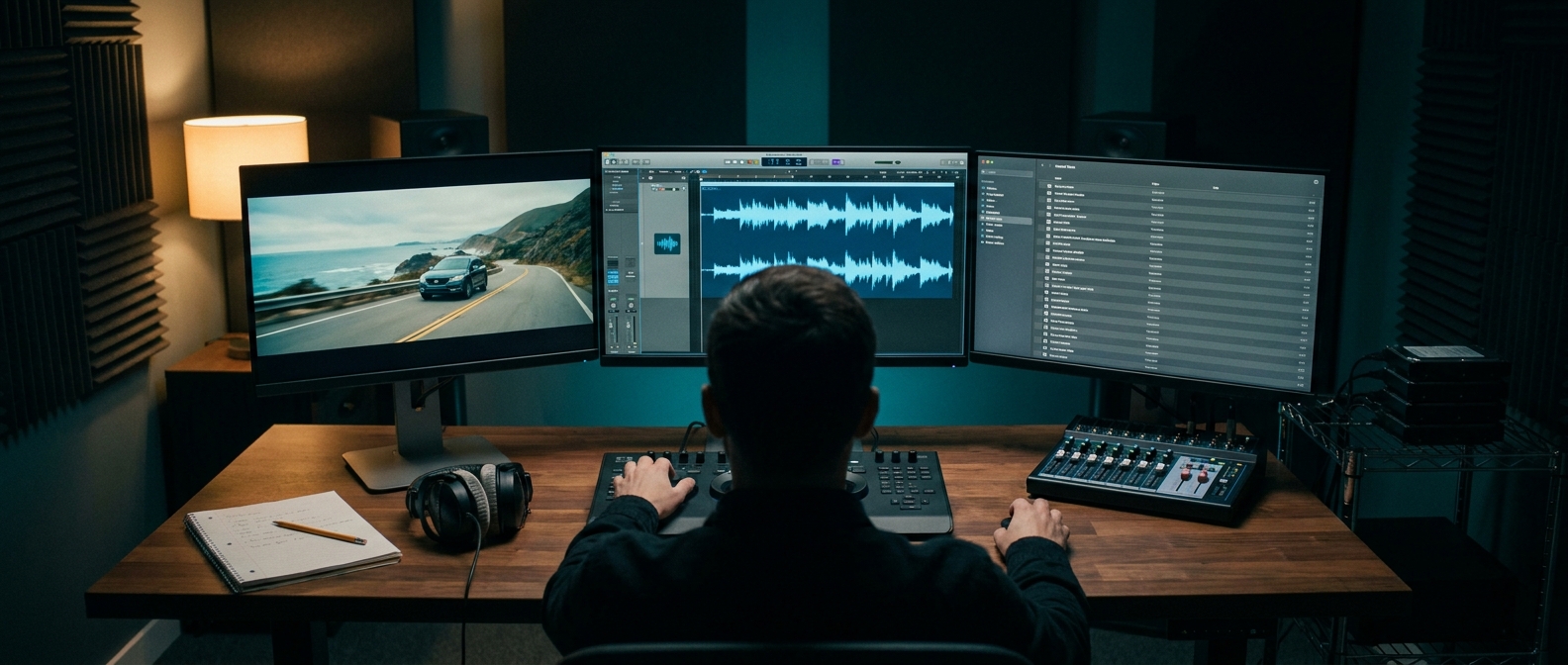
More than a catalog
Most people picture a production music library as a website with a play button and a price. That is the front door, not the building. The services offered by production music libraries are the difference between a track you found and a track you can actually run, on time, against the cut you have, without a claim landing six weeks later.
It helps to read the offering as a stack rather than a menu. Catalog access sits on top. Underneath it run the brief service, the deliverable formats, the customization room, and the rights work that holds the whole thing together. A library that only does the top layer is really a stock site wearing the word library. The rest of this piece walks each layer in the order a real project tends to hit them.
The standard service stack
Strip away the marketing and a serious library offers four things. You can run a whole project touching only the first, or all four on a complicated one, but a library worth the name can do every layer without sending you somewhere else.
Catalog access and search
Self-serve browsing of the cleared catalog, filtered by mood, tempo, genre, instrumentation, and use case. At GMP that is sixty thousand cleared, broadcast-ready tracks, with watermarked WAVs you can drop against your cut before anyone signs anything. This is the layer people think of as the whole service. It is one fifth of it.
Brief intake and curated shortlists
When you do not have time to dig, you send a brief and a person sends back a short, considered list. This is where a library earns its keep against a stock site, because the value is the judgment, not the database. GMP turns a curated shortlist around in one business day.
Deliverable formats
Stems, pre-built durations, loops, and stingers, shipped in the formats an edit room and a broadcast deliverable spec actually need. The cue you locked is useless if it arrives as a single stereo file when your timeline needs the bed pulled out under VO.
Clearance and rights management
The license itself, the scope it grants, and the documentation that survives a legal review or a network compliance check. This is the layer nobody sees until it fails, which is exactly why it belongs at the foundation of the stack rather than the afterthought.
Custom briefs and curated shortlists
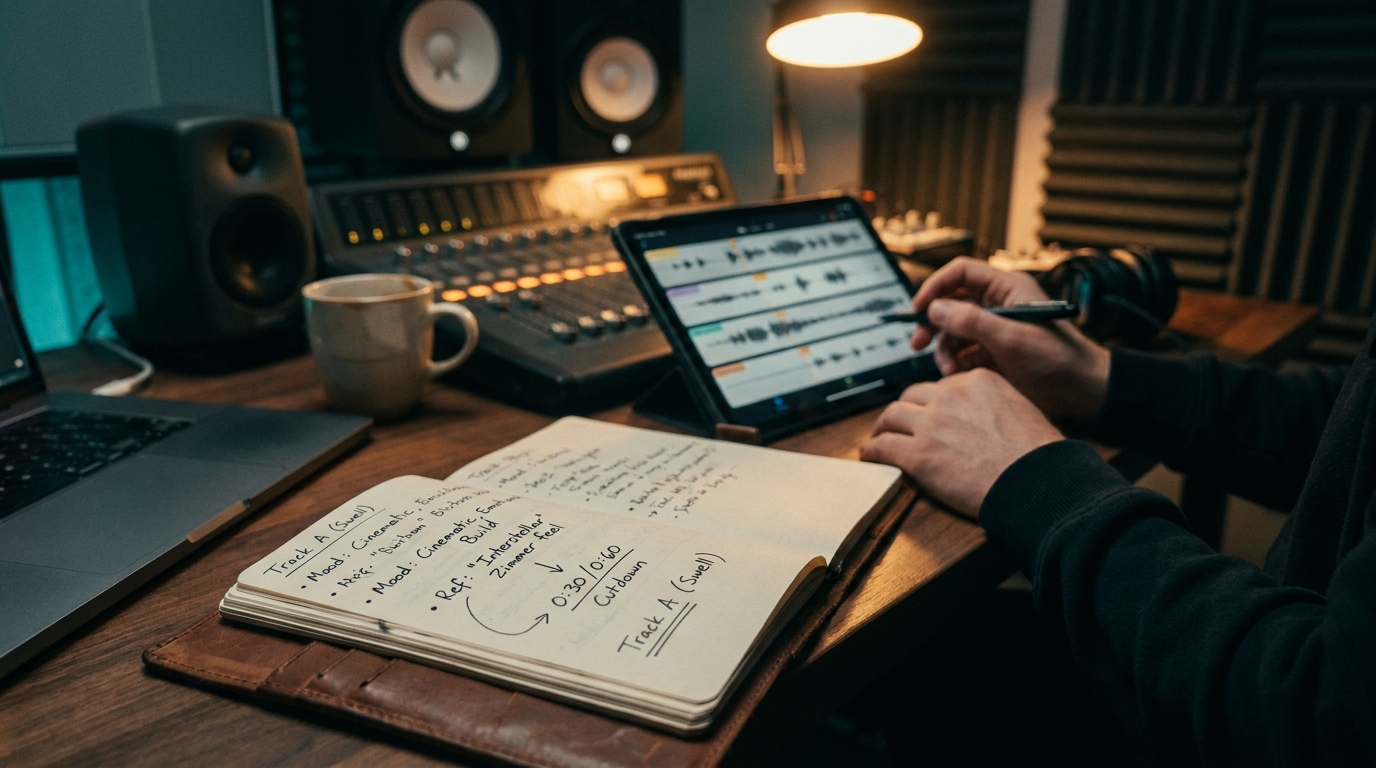
A search box is great until you have forty minutes, a creative director with a feeling, and no vocabulary for it. The brief service exists for exactly that moment. You describe the scene, the reference, the duration, and the energy arc, and a human who knows the catalog comes back with five or six cues that fit, not five hundred that match a tag.
The quality of what you get back tracks almost perfectly with the quality of what you send. A vague brief gets a vague list. A tight one gets a shortlist you can lock from. The fields worth filling in:
- The picture: what is on screen, the pace of the cut, and where the music should lift or pull back.
- Reference tracks: two or three cues that capture the feel, with a note on what specifically you are after in each.
- Duration and structure: total length, plus where you need a build, a drop, or a button.
- Use and scope: where it runs, broadcast or social or theatrical, so the shortlist only contains cleared options.
- What to avoid: the genre, era, or instrument the room has already ruled out.
Send that, and GMP returns a curated shortlist within one business day. The point of the service is not to replace your taste. It is to put five defensible options in front of it fast.
Stems and pre-built edits
Selecting the cue is the start of the deliverable conversation, not the end. Two services live in this layer, and whether they cost extra or ship standard tells you a lot about a library before you ever read its license.
Stems
Multitrack stems let the edit room treat the cue as raw material rather than a fixed object: drop the bed under dialogue, push the percussion up for a hit, mute the lead so a sound effect can breathe. At GMP, stems ship standard with every cue. There is no separate request and no version upcharge.
Pre-built durations
Most cues arrive with a set of durations already cut: a 60, a 30, a 15, a stinger, and a loop. That covers the standard spot lengths out of the box, so the edit room is not waiting on a request to make the cue fit a timeline.
Clearance and rights management
This is the service that makes the other four matter. A recorded cue carries two separate copyrights, the master recording and the publishing, and a usable clearance covers both. The reason library music exists as a category is that one party can grant both at once, instead of leaving you to assemble signatures from a label, a publisher, and a few co-writers who have never been in the same room.
Scope is the other half of the rights service. Three variables set it: term, territory, and media. A traditional deal prices each one separately and reprices every time you expand. A production library writes a flat scope so the figure is known before you commit. GMP owns master and publishing at the source and sets scope at worldwide, all media, with no expiry as standard. No renewal date, no scope upcharge when the social cut becomes a broadcast spot.
Coverage for trailers and high-stakes promos
Trailers and high-stakes promos sit at the demanding end of the catalog, because they live and die on hits, builds, and risers that have to land on a specific frame. A library that takes this seriously builds out a deep trailer section with the structural variety the format needs: clear builds, distinct risers, fight-or-flight percussion, and braams that read on a single drop.
With stems on every cue and pre-built durations already in hand, the edit room can shape the cut to the frame using the materials shipped with the license. The trailer house is not waiting on a new file; it is working with the multitrack to land the hit it already heard in the picture.
The throughline across the stack is speed without a rights gap. Once a cue is confirmed and the use is standard, the full mix, stems, and edit set deliver same-day. Curated shortlists come back inside one business day. The service stack is built so the licensing stops being the part of the job you dread and goes back to being a creative call about which cue serves the cut.