
What each term actually means
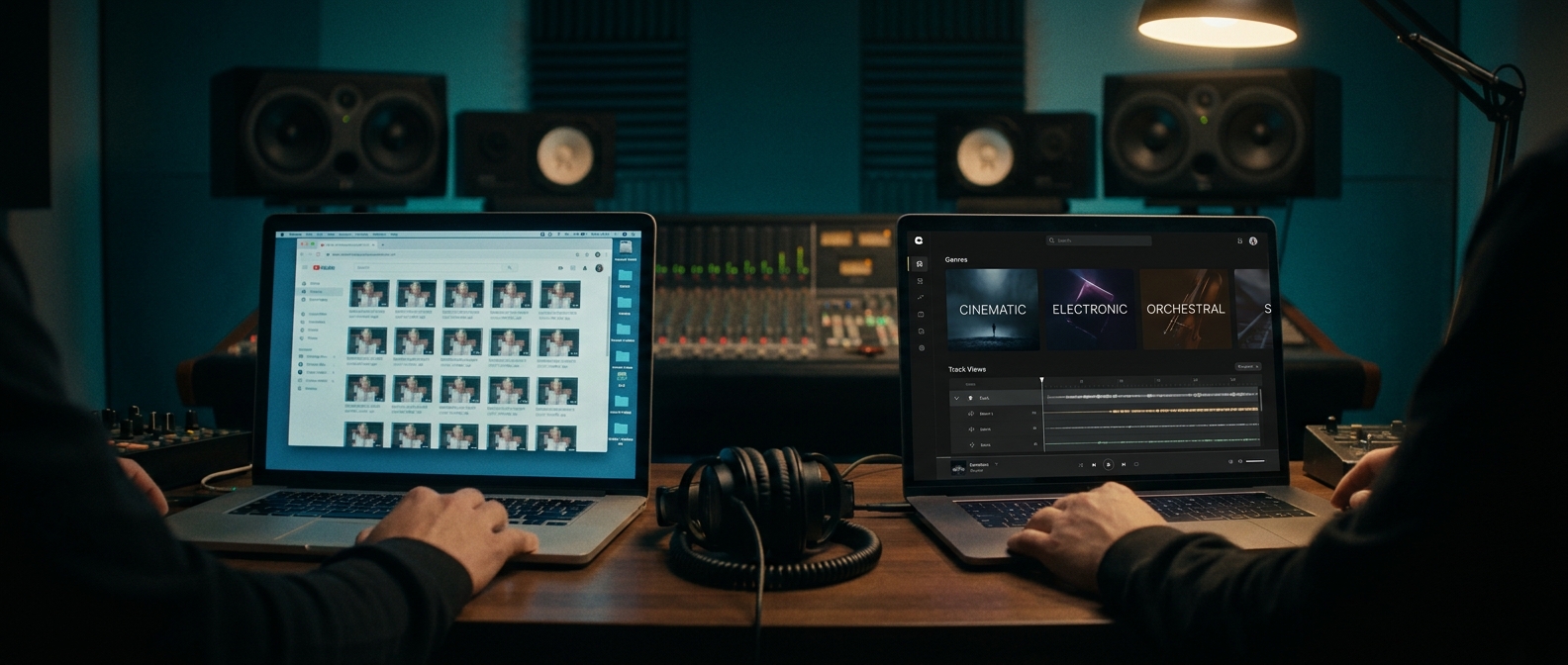
Start with the words, because the loose usage is half the problem. People say stock music, royalty-free music, and production music as if they were three names for one thing. They are not. The first describes a buying model, the second describes a pricing structure, and the third describes a category of catalog built for a specific job. Stock music vs production music is really a question about who made the track, who controls the rights to it, and what they promise you when you put it on air.
Stock music
Stock music is the broad marketplace tier: large platforms where independent composers upload tracks and you buy a download, usually under a royalty-free or subscription license. The model is volume. Huge libraries, low per-track prices, instant checkout, and a license written to cover the most common low-risk uses. The composer keeps their own rights and grants you a use; the platform is a storefront in the middle, not the owner of the music.
Production music
Production music is catalog written and recorded specifically to be licensed against picture. A production library commissions the work, holds the rights to it, and licenses it directly to the people clearing it. That sourcing difference is the whole story. Because the library owns what it sells, it can stand behind the clearance, ship the working files, and write scope wide enough for broadcast without going back to anyone. GMP Music has run this model since 1986, with more than sixty thousand cleared tracks under one roof.
The clearance and quality gap
Two tracks can sound interchangeable in a preview player and behave nothing alike the moment a takedown notice or a usage audit shows up. The difference is not the waveform. It is what stands behind it.
Who actually clears the track
A recorded track carries two separate rights, the master and the publishing, and a clean license has to cover both. On a stock platform the composer holds those rights and the platform passes through a license on their behalf. That works until it does not. If the composer sampled something, registered the composition with a collection society that later files a claim, or pulled the track from sale after you shipped, the platform is rarely positioned to make you whole. You bought a copy and a promise; you did not buy ownership-backed certainty.
Production music collapses that risk because one party holds both layers at the source. GMP commissions the cue, owns the master and the publishing, and clears both with a single license. There is no second rights holder to surface a claim, because there is no second rights holder. What you sign is one document, not a chain whose end you cannot see.
The quality floor, not the ceiling
Stock libraries run on open submission, which means brilliant cues and rough demos sit on the same shelf with the same star rating, and you do the sorting. A curated production library inverts that. Tracks are commissioned to a standard, mixed for broadcast, and mastered to deliver, so the floor is high and consistent rather than a lottery you run search by search. The point is not that stock never sounds good. It is that you cannot count on it sounding good, and counting on it is the job.
Stems and pre-built edits
Past the license, the daily difference between stock and production music is what lands in the delivery folder. Edit rooms do not work from a single stereo file. They work from parts and durations that already fit the timeline.
- Stems: the multitrack parts (drums, bass, keys, strings, signature instrument) so an edit room can pull elements down under dialogue or push them up for a hit. On stock platforms stems are a sometimes thing, often a paid tier. At GMP they ship standard with every cue.
- Edits and durations: pre-built 60, 30, 15, stinger, and loop versions cut for real ad and broadcast slots, so you are not crudely chopping a three-minute upload to fit a thirty-second spot.
- Catalog depth: a stock platform tends to offer one or two versions of any given cue. A production library carries enough adjacent material that the alternate read of a cue you almost loved is usually a few filters away.
Depth and stems together do most of the work that stock platforms cannot match. The cut wants a darker arrangement of the cue you almost picked? In a sixty-thousand-track catalog organized by mood, intensity, and instrumentation, that variant is usually a search away rather than a request you have to file with the original composer who is no longer available.
Cost over the campaign lifecycle
Compare stock and production music on the first invoice and stock wins on the spot. Compare them across the life of the content and the math frequently flips, because the headline price is not the price. The license terms are.
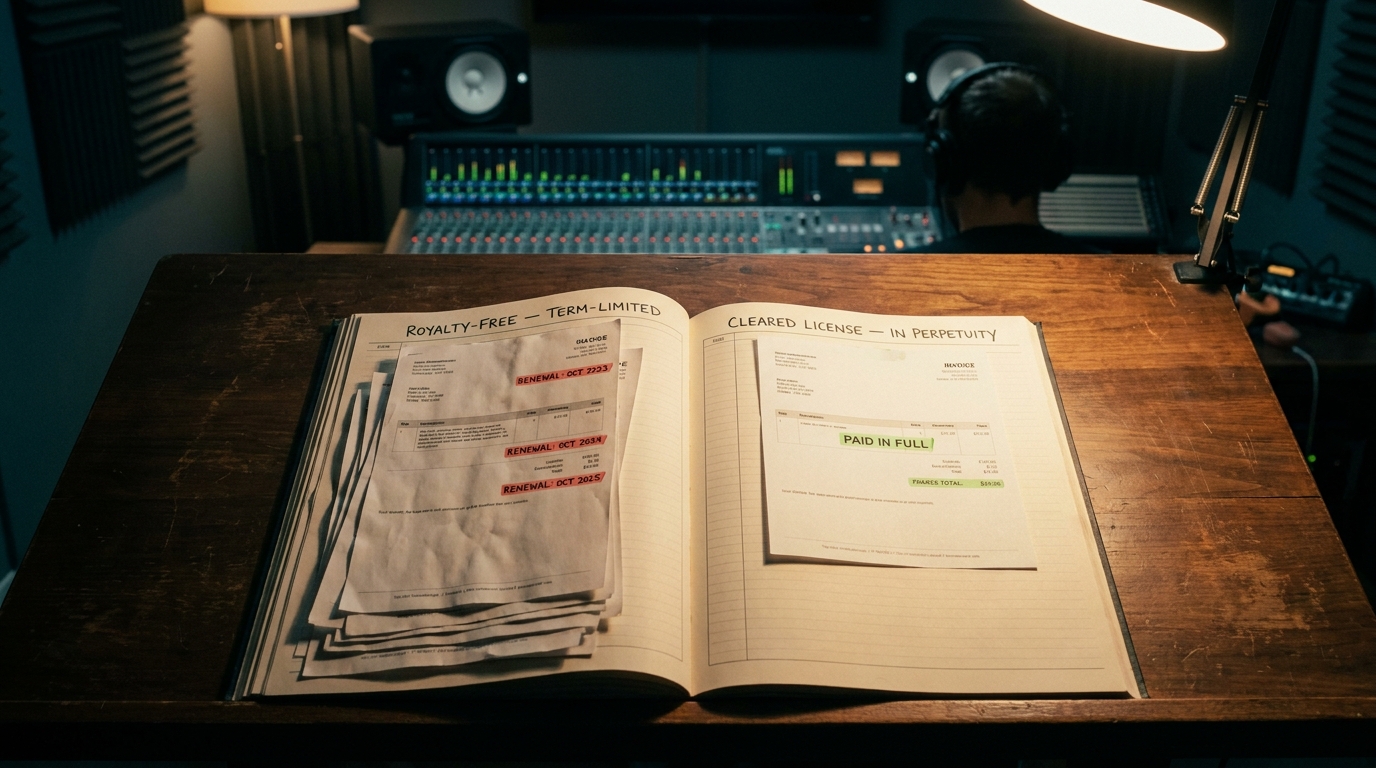
Many stock and royalty-free licenses are term-limited and scope-limited by design. The cheap checkout covers a year, or one platform, or one territory, or organic social but not paid. Push the spot to broadcast, run it in a second country, keep an evergreen video live past the term, and you are buying the rights again or pulling the work. None of that shows up at purchase. All of it shows up later, usually when the content is performing and you least want to touch it.
This is where the comparison stops being about taste and starts being about exposure. A thirty-dollar stock cue on a national campaign can quietly cost more than a flat-rate cleared cue once you total the renewals, the scope expansions, and the one audit that goes badly. Predictable scope set before you commit is worth more to a brand on a calendar than any single cheap download.
When stock music is the right call
None of this means stock music is a trap to avoid. It means stock music is a tool with a fit, and using it outside that fit is where people get burned. There is a real lane where it is genuinely the smart, fast, economical choice.
- Low-stakes, short-life content: a one-off internal recap, a draft animatic, a temp track on a rough cut that will be replaced before delivery.
- Tight personal or small-scale budgets where the use is organic, single-platform, and unlikely to scale into paid distribution.
- Volume work where speed beats certainty and no single piece carries brand or legal weight.
Where it breaks down is exactly where production music was built to live: paid commercial work, national or broadcast exposure, evergreen content meant to run for years, anything carrying a brand's name, and any project where stems and catalog depth are part of the craft. The moment the cost of getting clearance wrong exceeds the price difference between a download and a cleared cue, the comparison is over. That threshold arrives sooner than most buyers expect.