
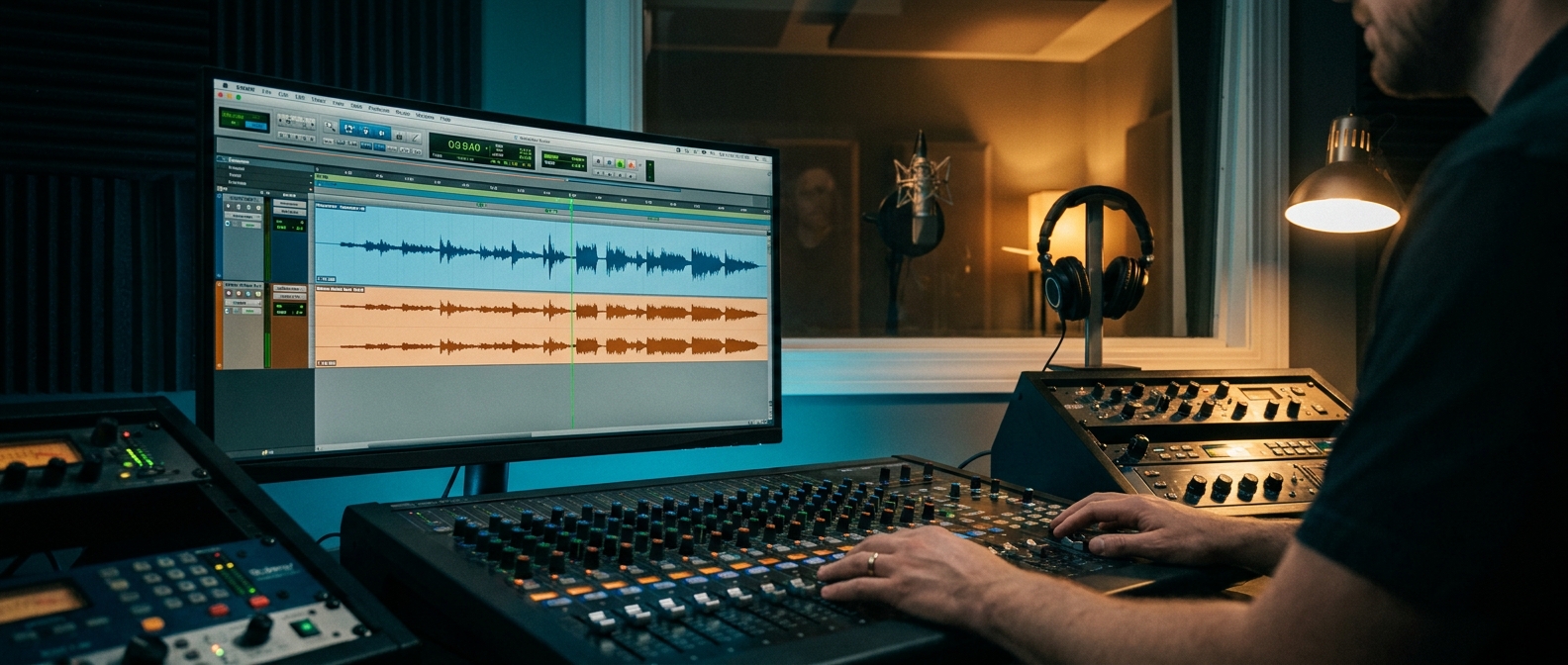
Why podcast music needs its own clearance
A podcast is not a closed file you hand to one platform. It is an RSS feed that fans out to Spotify, Apple Podcasts, YouTube, Amazon Music, and every directory that scrapes the feed. The moment an episode publishes, your intro music is sitting on platforms that run automated content matching against the world's recorded catalog. If the track you used is registered to a rights holder you never cleared with, the match is found, and the claim arrives on its own schedule.
That is what makes podcast music quietly riskier than people expect. The exposure is wide and the distribution is out of your hands. You cannot quietly swap a track on every mirror at once, and a flagged episode can be muted, demonetized, or pulled while you are mid-season. For a show that takes sponsorship money, runs ads, or carries a brand's name, that is a commercial use, and commercial use needs a real license, not a vibe and a hope.
The rights a podcast actually needs
Most podcasters think licensing music is one transaction. It is two rights, and a clean podcast clearance has to settle both. Clear one and miss the other and you have a track that is half-licensed, which is the same as unlicensed the day a matching system flags it.
The recording and the song
The master is the specific recording in your episode, the exact file. The publishing is the composition underneath it, the melody and arrangement as written. On a commercial release these belong to different parties, sometimes several of them, and any one can object to a podcast use. A production library that holds both at the source collapses that into a single grant, which is the difference between an afternoon and a month.
Scope that fits a feed
Then there is scope: how long the clearance lasts, where it runs, and which platforms it covers. A podcast wants worldwide, because RSS does not stop at a border. It wants streaming and broadcast and social, because clips of the episode end up on YouTube and Instagram. And it wants no end date, because an episode published today is still in the feed in five years, still playable, still scannable.
- Master and publishing both cleared, from one party, in one license.
- Worldwide territory, because the RSS feed has no geography.
- Streaming, broadcast, social, and theatrical media in one grant, so clips and trailers are covered too.
- Cleared in perpetuity, so a back-catalog episode never turns into a renewal invoice.
Royalty-free vs. production music for podcasts
The cheapest path is a royalty-free or stock track grabbed from a marketplace, and for a hobby show with no money moving through it, that can be fine. The trouble starts when the show earns. Royalty-free licenses are frequently term-limited, narrow on platforms, or silent on exactly the question you need answered: is this cleared for a monetized podcast distributed everywhere, in perpetuity. When the license does not say yes in writing, you are exposed even if nobody has flagged you yet.
There is also the matching problem. Popular royalty-free tracks get used thousands of times, and content systems on YouTube and elsewhere sometimes flag legitimate uses because another uploader claimed the same audio. Now you are filing disputes on your own episode to prove you had the right to the music you paid for. Production music sidesteps that. The cue is licensed to you directly by the library that owns it, with paperwork that names the use.
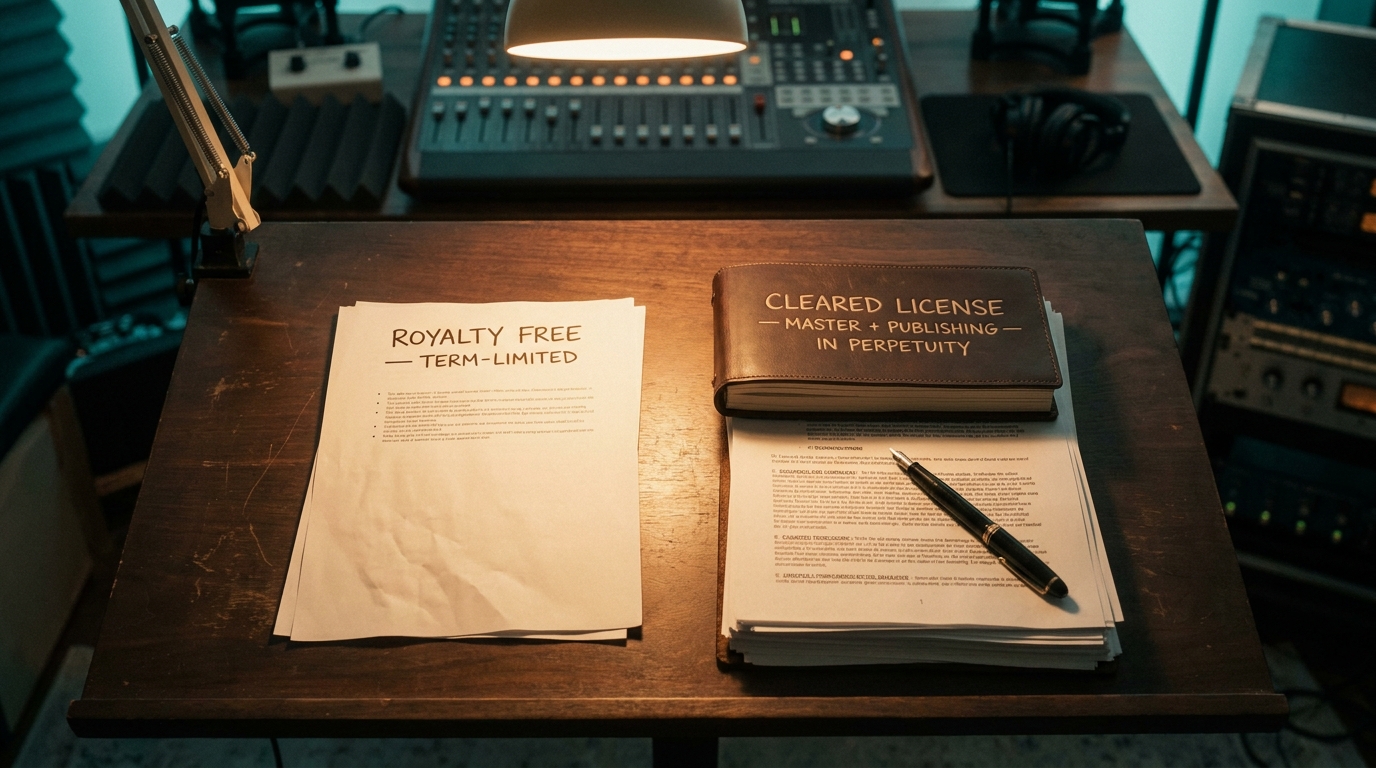
Position it this way. Royalty-free optimizes for a low first invoice. Production music optimizes for never thinking about the track again. For a show with a sponsor, a network, or a brand attached, the second is the cheaper option once you count the cost of a single pulled episode.
The GMP licensing flow for podcasters
Licensing music for podcasts through a single-source library is meant to be the boring part of the production, and at GMP it runs in four steps from open brief to delivered files.
- Search the catalog yourself, or send a brief, the show's tone, the energy of the cold open, the length of your intro, and get a curated shortlist back within one business day.
- Audition watermarked WAVs against your actual edit until the intro and beds lock.
- Confirm the cues and the use. We issue a flat-rate license, cleared worldwide and in perpetuity, with no scope negotiation.
- The full mix, stems, and pre-built 60/30/15/stinger/loop durations deliver same-day on confirmation.
Those pre-built durations matter more for podcasts than people assume. An intro wants a clean 15 or a stinger, a mid-roll bumper wants a tight loop under the host's read, and an outro wants something that resolves while the credits run. Because the edit set ships with the cue and stems come standard, your editor builds all of that without going back to request another file or paying a version upcharge.
Common mistakes that cause takedowns
Most podcast music problems are not malice. They are small assumptions that hold until distribution scale catches them. These are the ones that recur.
Treating free as cleared
A track labeled free to download is not a track cleared for commercial podcast use. Free usually means no upfront cost for personal listening, with monetized distribution explicitly excluded in the fine print. The download was never the license.
Skipping the Creative Commons fine print
Creative Commons can be genuinely usable, but the attribution and non-commercial clauses are conditions, not suggestions. A non-commercial CC track on a sponsored show breaks the license, and a missing credit can void it entirely. Read the specific license, not the headline.
Forgetting the clips
Even when the main feed is cleared, the audiogram on Instagram, the YouTube cut, and the trailer all carry the same music to platforms with their own matching systems. A license that covers podcast streaming but not social leaves the promo clips exposed. Clear for all media up front so the whole life of the episode is covered.