
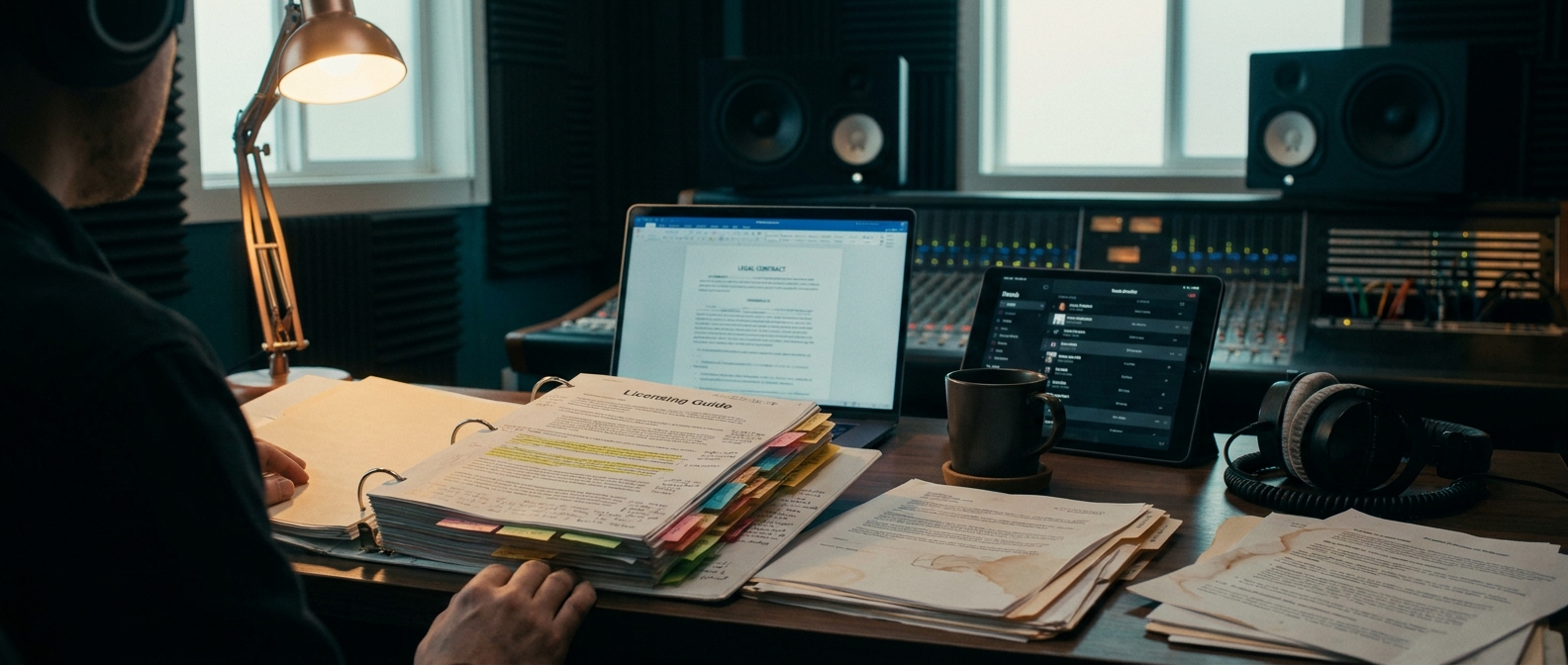
The five license types
Music licensing reads like one thing and behaves like five. A single piece of recorded music can sit under several different permissions at once, depending on what you are doing with it, and each permission has its own owner, its own paperwork, and its own price. The reason a track that cost three dollars on a download store can still get your campaign pulled is that buying a copy never touched any of these five. They are the actual product.
Before we walk through when each one applies, here is the full set in plain language. Read them as a stack, not a menu. Many buyers need two or three at the same time without realizing it.
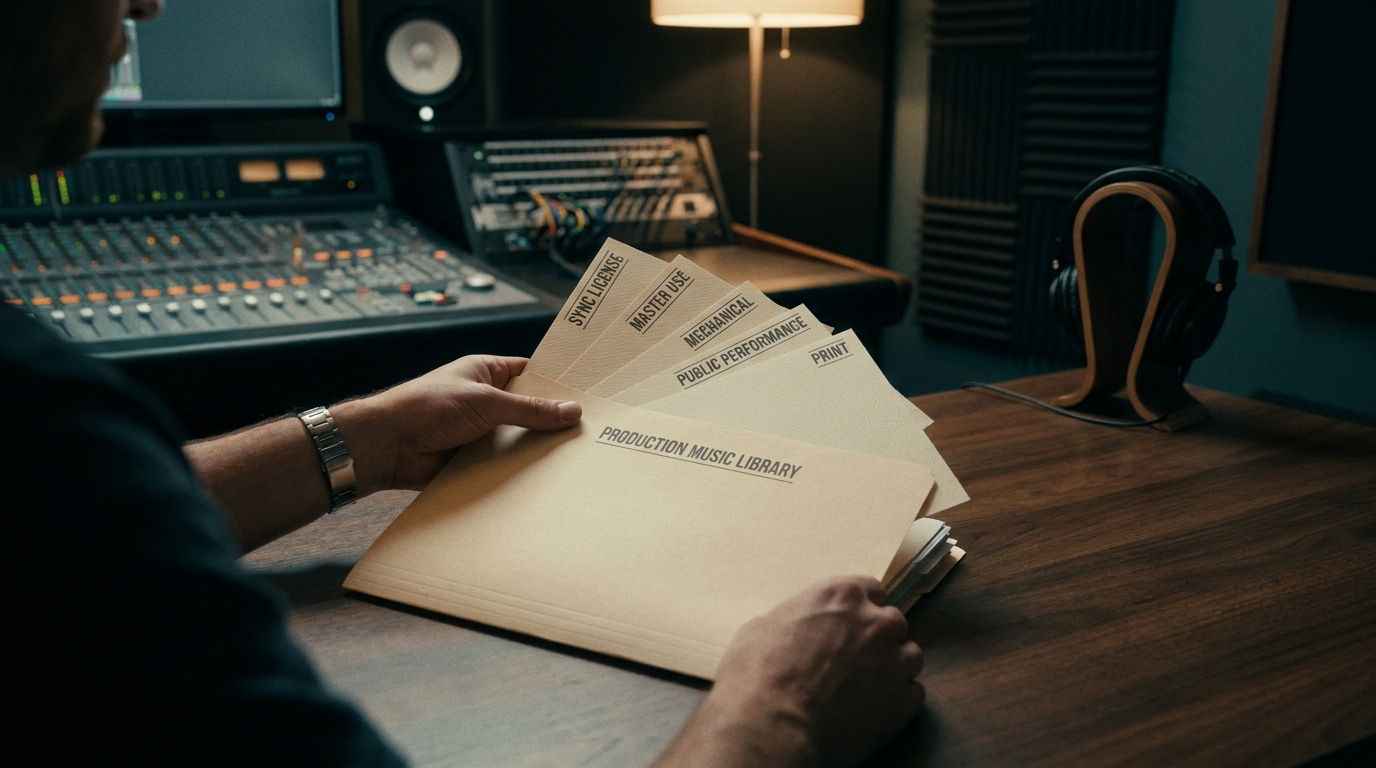
- Sync license: pairs a piece of music with moving picture. Required the moment a track runs under a commercial, a film, a trailer, or a podcast with video.
- Master use license: covers the specific recording, the literal audio file you want to use, granted by whoever owns that master.
- Mechanical license: covers reproducing and distributing a composition, the rights you need to press copies, sell downloads, or stream a cover you recorded.
- Public performance license: covers playing music to an audience, on broadcast, in a venue, over a streaming service, and is administered by the performing rights organizations.
- Print license: covers reproducing the written notation or lyric, the one most buyers never touch unless they are publishing sheet music or putting a lyric on screen.
When each license actually applies
The list above is the vocabulary. The harder skill is knowing which ones your specific project triggers, because nobody hands you a checklist. A national spot pulls a different set than a podcast intro, and getting the set wrong is how an uncleared track ends up in front of a paying audience.
Sync and master use, almost always together
If recorded music meets picture, you need a sync license for the composition and a master use license for the recording. These two travel as a pair for nearly every commercial project: ads, brand films, social cutdowns, documentaries, game cinematics, trailers. People say sync as shorthand for both, but they are separate grants from potentially separate owners, and a deal that clears one without the other is not cleared at all.
Public performance, working in the background
Public performance is the one that runs whether you think about it or not. When your spot airs on television, when the film screens in a theater, when the content streams, a performing rights organization is logging the use and collecting on the songwriter's behalf. Broadcasters and venues usually hold blanket performance licenses, so the buyer rarely signs this one directly. It still exists, and it still matters, because it is part of why the composition has value at all.
Mechanical and print, the edge cases
Mechanical licensing governs reproducing and distributing a composition as audio: pressing a record, selling a download, releasing a cover. Most video and brand work never triggers it, but a music-driven app or a release product can. Print is rarer still, reserved for reproducing notation or putting a lyric on screen. You can run an entire campaign and never meet either one, which is exactly why they ambush the people who do.
How a production library collapses the stack
Here is where the five-part structure stops being a hazard and starts being a non-issue. The reason the stack is dangerous on the open market is fragmentation: the master sits with a label, the publishing splits across co-writers and their companies, and the performance side answers to its own organizations. Clearing one recognizable song can mean chasing four or five signatures who have never spoken to each other, and any one of them can stall or kill the deal at the last desk.
A production music library is built to remove that chase. When master and publishing are held at the source, the sync grant and the master use grant come from the same party in the same document. There is no second negotiation waiting behind the first. The five-type complexity does not disappear from the law; it disappears from your desk.
Self-clearance versus library-cleared
Once you understand the stack, the real decision in front of most buyers is whether to clear a track yourself or pull one that is already cleared. These are genuinely different jobs, not two prices for the same thing, and the right call depends on what the project actually needs.
Clearing a known song yourself
You go down this road when only a specific famous track will do, and the brief can absorb the time and the cost. Expect to identify every rights holder on both the master and the publishing side, request quotes for your exact scope, negotiate term and territory and media separately, and wait. Weeks is normal. A clean no from a single co-writer can end the whole effort after a month of work. When it lands, though, you have the song nobody else can offer, and sometimes that is the entire point.
Pulling a library-cleared cue
You go this way when the project needs the right music more than it needs a particular recording the audience already knows. The clearance is done before you arrive. The scope is flat and broad. The figure is knowable before you commit, which is something the self-clearance path can almost never promise. For anything on a calendar, that predictability tends to outweigh the pull of a famous master.
Choosing a library worth signing with
Not every library that calls itself cleared clears the same things, and the gaps rarely show until a claim arrives. If you are going to route music through a single source, these are the questions that separate a real one-stop from a marketplace that just looks like one.
- Does the library hold both master and publishing, or only license the recording and leave you to chase the song separately.
- What is the default scope. Worldwide, all media, in perpetuity should be the baseline, not an upgrade tier with a scope upcharge.
- Do stems ship with the cue, or do you request them later and pay extra for the multitrack you needed all along.
- Are multiple durations built and included. A 60, a 30, a 15, a stinger, and a loop should arrive with the track, not as separate orders.
- How fast does delivery actually move once a cue is confirmed, in hours or in a queue you cannot see.
GMP answers each of those the same way: both rights owned at the source, worldwide scope with no expiry as the baseline, stems included with every cue, the full duration set built in, and same-day delivery on cue confirmation with one-business-day turnaround on a curated shortlist. The catalog has run continuously since 1986 for a reason, and the reason is that working buyers come back to a source that does not surprise them.
Pitfalls to avoid
Most licensing trouble is not exotic. It comes from a handful of assumptions that feel reasonable right up until the claim lands. A producer once told us the track was never the holdup; the names on the paperwork behind it were. These are the ones that catch people.
- Treating ownership of a file as permission to use it. Buying or downloading a track clears none of the five license types.
- Clearing the master and forgetting the publishing, or the reverse. A half-cleared track behaves exactly like an uncleared one when a claim arrives.
- Reading royalty-free as license-free. Royalty-free usually means term-limited and scope-limited, which is where the second invoice comes from.
- Ignoring scope until it bites. Run a spot in a second country or push it from social to broadcast under a narrow license and you are out of compliance without touching the music.
- Requesting stems and edits after the fact. If the multitrack and the alternate durations are not part of the original grant, you are negotiating again in the middle of the edit.
Every one of these traces back to fragmentation: rights split across owners, scope split across line items, deliverables split across requests. The whole argument for a single-source library is that it closes those seams before you ever see them, so the music goes back to being a creative decision instead of a legal one.