
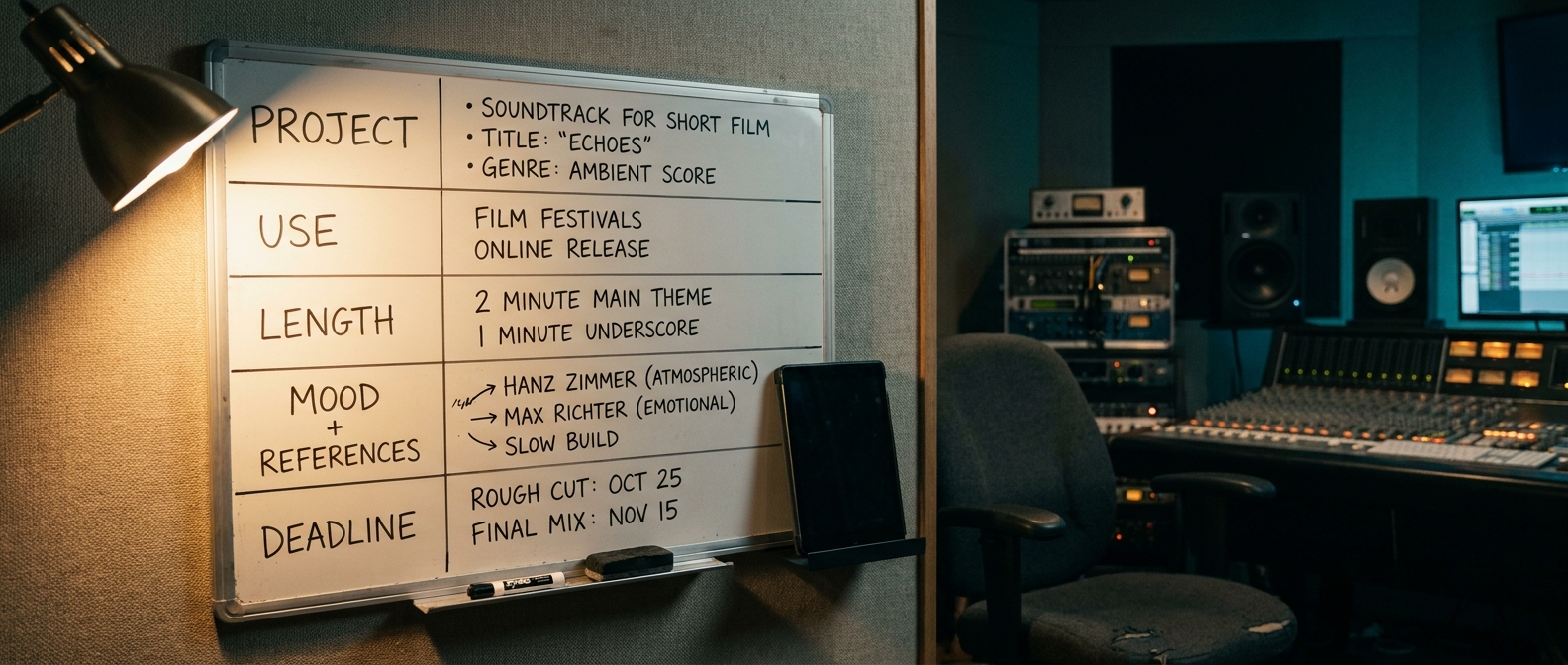
What a music brief is, and why it stalls
A music brief is the short document you hand to a library or a supervisor that says what the music has to do. Not what you like. What the scene needs. The gap between those two is where most briefs go sideways, because a request built from taste produces a shortlist that flatters your ear and ignores your edit.
The good news is that a workable brief is mechanical. There are five fields it has to answer, and once they are filled in clearly, the person on the other end can pull cues with confidence instead of guessing. The rest of this piece walks those five fields, the references that help versus the ones that hurt, how a supervisor actually reads what you send, and the mistakes that quietly waste a week.
The five fields every brief needs
Strip a brief down and five things carry it. Skip any one and the reader fills the gap with an assumption, and their assumption is rarely yours. Send these and you have given a stranger enough to find your cue on the first try.
- Project: what you are scoring and for whom. A national skincare spot, a founder documentary, a SaaS explainer, a horror trailer. The context sets the whole register before a single adjective.
- Use: where the music sits and what it competes with. Under voiceover, wall-to-wall instrumental, a needle-drop at the reveal, a bed behind dialogue. Music that wins a solo loses under narration.
- Length: the exact duration and the shape of the cut. Thirty seconds with a hit at twenty-two. A three-minute piece that builds twice. Pre-built durations matter here, so name them.
- Mood plus reference tracks: two or three adjectives and two or three real examples. Adjectives set the lane, references set the lane markers. One without the other drifts.
- Deadline: the real date you need delivery, not the date you are comfortable saying. Turnaround drives how wide the shortlist can go and how much of the catalog the curator can audition against your cut.
Notice that none of these is a genre tag. Genre is a useful filter once the lane is set, but a brief that opens with "we want indie folk" and stops there has told the reader almost nothing about what the scene is doing. Lead with the work, let the genre fall out of it.
What references to send, and what to leave out
References are the highest-leverage part of a brief and the easiest to get wrong. The instinct is to send the most famous track that sounds roughly right. Resist it. A reference is a coordinate, not a wish.
References that actually help
Send two or three tracks and, for each, one line on what specifically you want from it. "This one for the tempo and the restraint, not the vocal." "This one for the build at the chorus, ignore the lyric." That single annotated line does more work than ten unlabeled links, because it separates the part you want from the parts you do not.
References that mislead
Leave out the famous master you could never clear and would never budget for, unless you flag it plainly as a vibe target. Otherwise the reader spends effort chasing a sound that exists to be unaffordable. Leave out the track you love that has nothing to do with the scene. And leave out references that contradict each other without a note on which one wins, because a brief that points two directions points nowhere.
Give me three references and tell me what you want from each one, and I will hit it on the first pass. Give me ten links and no notes, and I am just guessing in your direction.
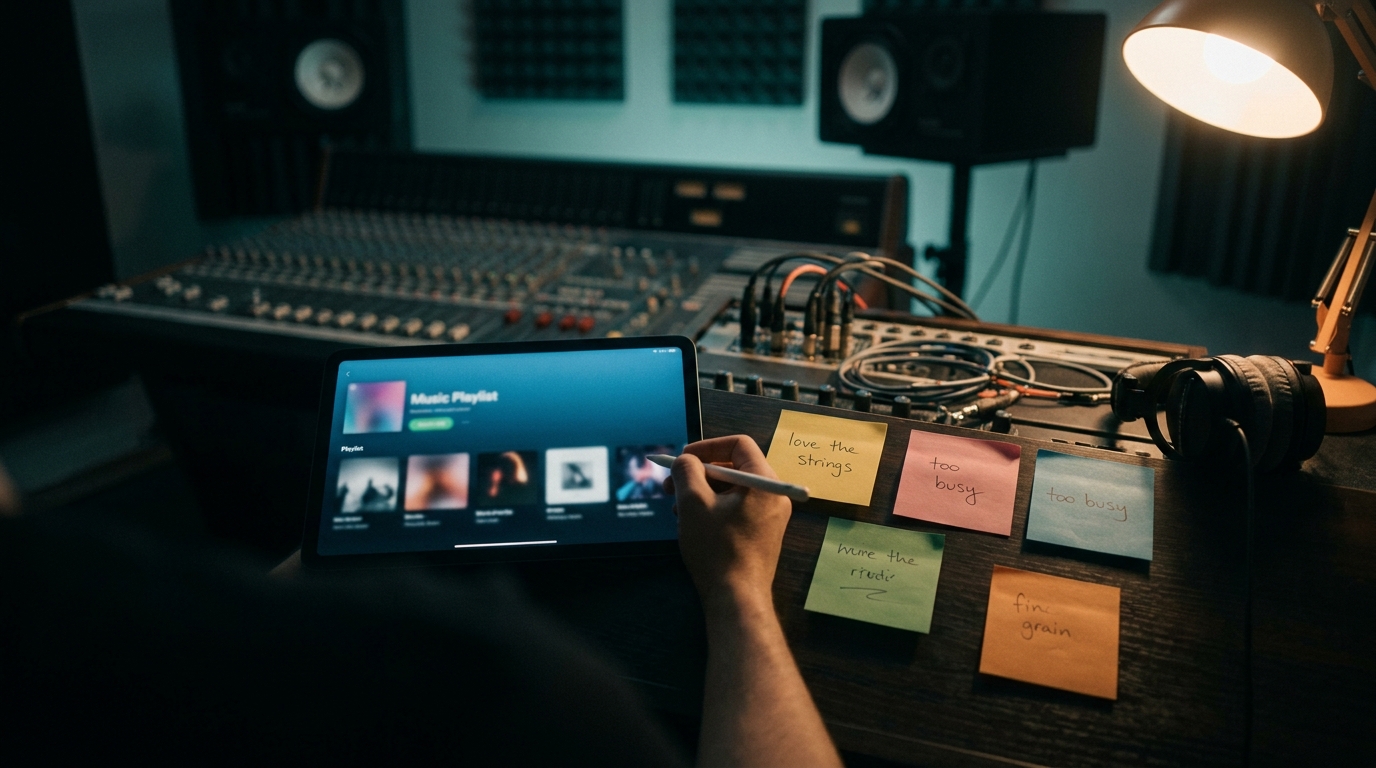
How a music supervisor reads your brief
It helps to know what happens on the other side. A supervisor or a library curator does not read your brief as prose. They read it as a filter stack, and they apply it in order.
Deadline tells them how wide they can cast across the catalog. Use and length tell them the function, which quietly eliminates more cues than any adjective will. Project sets the register. Then, and only then, do mood and references narrow the lane to a shortlist. The reason a vague brief returns a bad list is not laziness on their end. It is that you left the early filters empty, so the whole stack ran on the loosest possible setting.
Common brief mistakes that cost a week
None of these are exotic. They are the everyday ways a brief quietly fails, and each one adds a round of back-and-forth you did not budget for.
- Adjectives with no anchor. "Epic but intimate, modern but timeless" describes most of the catalog. Pair every adjective with a reference or a function.
- No length or the wrong length. Asking for a cue without a duration means the edit set may not exist when you need it. Name the 60, the 30, the 15, the stinger, the loop.
- Hiding the deadline. Soft dates produce soft shortlists. The reader paces the work to the date you give, so give the true one.
- Burying the use. "Goes under a voiceover" changes everything and belongs in the first two lines, not discovered on the third revision.
- Sending taste, not spec. The track you would play in the car is not the brief. The track the scene needs is.
There is a quieter mistake worth naming on its own: treating clearance as a later problem. If the brief comes back full of cues you cannot license cleanly, the creative win evaporates at the legal desk. A single-source library removes that risk before the shortlist is even built, because every cue on it is cleared in perpetuity, worldwide, with stems standard. There is no renewal date and no scope upcharge waiting behind the cue you fall in love with.
The GMP brief template
Here is the whole thing as a fill-in. Paste it into an email, answer each line in a sentence, and you have a brief that returns a usable shortlist instead of a guessing game.
- Project: what is this, who is it for, where does it run.
- Use: under voiceover, wall-to-wall, needle-drop, or bed behind dialogue.
- Length and shape: exact duration, plus any hit, build, or drop and its timecode.
- Mood plus references: two or three adjectives, two or three tracks, one note per track on what to take from it.
- Deadline: the real delivery date you need files in hand by.
Send that and the rest is built to disappear. A curated shortlist returns the next business day, cut to your pre-built durations. You audition watermarked WAVs against the cut, confirm the cue and the use, and the full mix and stems deliver same-day on confirmation. The brief stops being the slow part of the project and becomes what it should have been all along: a creative call about which cue serves the story.