
How YouTube Content ID works
Content ID is YouTube's automated fingerprinting system. Rights holders upload reference files of the music they control, and every video that gets posted is scanned against that reference database. When a portion of your audio matches a fingerprint on file, the system raises a claim. It runs continuously, it does not read your intent, and it does not check whether you paid for the track somewhere else.
A claim is not a takedown, and that distinction matters. A claim is the rights holder asserting that their music is in your video and choosing what happens next. They can monetize your video by running ads against it and keeping the revenue. They can mute the audio. They can block the video in some territories or worldwide. Most creators meet Content ID the moment their first match resolves and the earnings on a video they made quietly route somewhere else.
Three sources of music on YouTube
Almost every track a creator considers comes from one of three places, and each carries a different risk profile on a monetized channel. Knowing which bucket your music sits in tells you, before you ever hit publish, whether a claim is coming.
Commercial releases
The song you know from radio or a streaming chart. The master sits with a label, the publishing sits with songwriters and their publishers, and both are almost certainly registered in Content ID. Using one without a sync license is the fastest way to hand your ad revenue to a major label, and on a channel with real reach it can escalate to a block or a strike.
Free and stock libraries
The vast middle ground: YouTube's own Audio Library, royalty-free download sites, and the cheap stock music marketplaces. Some of it is genuinely clear. A lot of it is term-limited, attribution-dependent, or shared across so many channels that the same track gets claimed by a third party who registered it first. The license you agreed to and the fingerprint in the database are not always telling the same story.
Cleared production music
Music written and owned to be licensed, where one party holds both the master and the publishing. This is the source built for commercial use, which is what a monetized YouTube channel is. A single license clears the recording and the composition, and a serious library can keep its own catalog from claiming you.
Why 'no copyright music' isn't safe
'No copyright music' is one of the most misleading phrases on the platform. There is no such thing as music without copyright. The moment a piece of music is recorded, it carries copyright automatically, both in the recording and in the composition. What those channels usually mean is 'free to use with attribution,' which is a license, not the absence of one. And a license has terms you can break.
Here is where it gets worse for a working channel. A track distributed for free to thousands of creators is a track that thousands of channels have published. If any one of those uploaders, or a distributor acting on the artist's behalf, registers the audio in Content ID, the fingerprint starts matching everyone, including you, who downloaded it in good faith. You did nothing wrong and the claim still lands. Now you are filing disputes instead of making videos.
I disputed a claim on a track the description swore was copyright-free. Three weeks later a distributor I had never heard of was collecting on my best video. The track was free. The cleanup was not.
Licensing production music for YouTube
Production music is the answer most creators arrive at once their channel earns enough that a claim hurts. The model is built around the exact problem Content ID creates: clear use, clear ownership, one signature. A single license from a single-source library covers both the master and the publishing at once, so there is no second rights holder waiting to surface a month after you publish.
GMP has run a production library since 1986, with more than sixty thousand cleared, broadcast-ready tracks. Every cue is licensed worldwide, in perpetuity, across broadcast, streaming, social, and theatrical use by default. For a YouTube creator that translates plainly: the track is cleared for your channel everywhere it can be watched, for as long as the video exists, with no renewal date sitting on the calendar waiting to lapse on your best-performing upload.
- One license clears the recording and the composition together, so no separate publisher claim arrives later.
- Worldwide rights by default, so the video is not blocked in the territories your audience actually watches from.
- Cleared in perpetuity, so an evergreen video that keeps earning never triggers a second invoice.
- Stems ship standard, so you can duck music under narration or lift it for a montage without requesting another file.
- Pre-built durations (60, 30, 15, stinger, loop), so intros, outros, and ad reads have a cut that already fits.
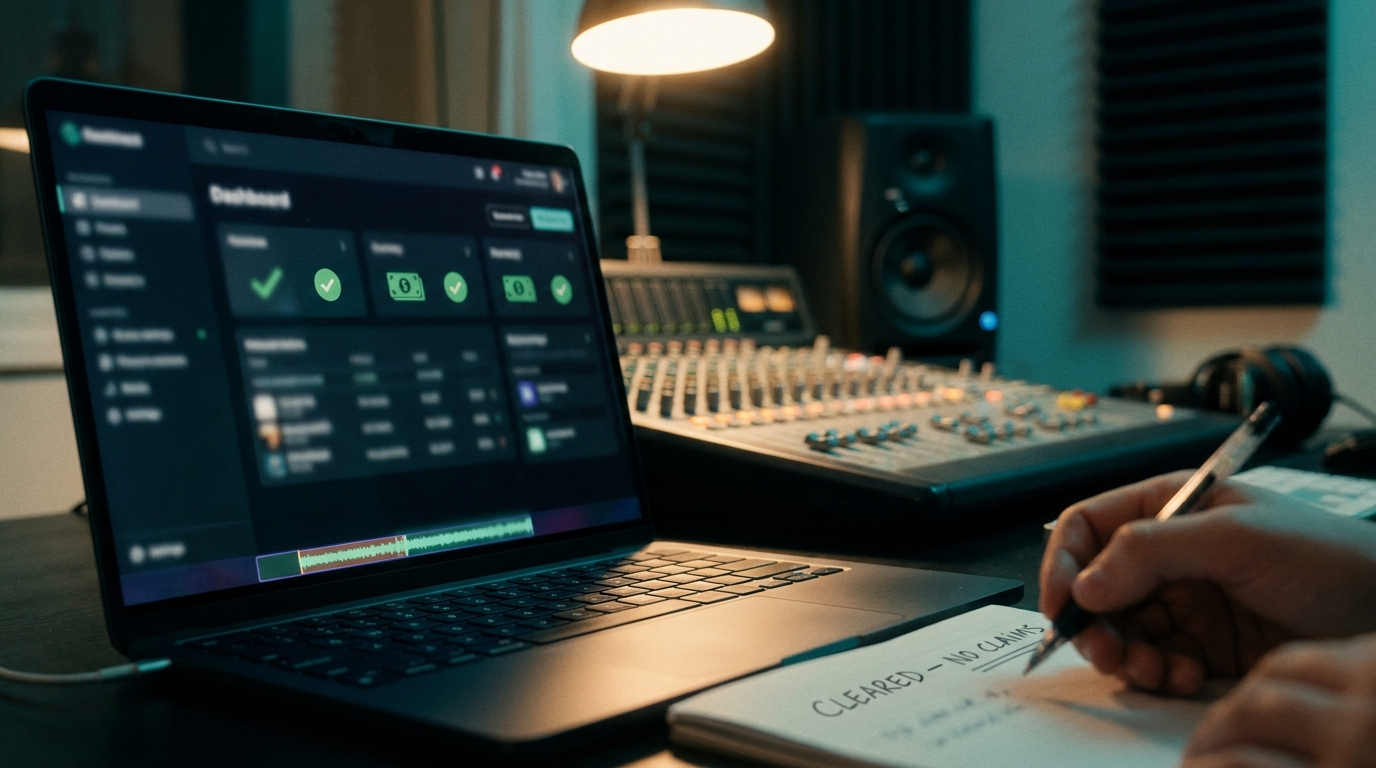
The practical workflow stays short. Search the catalog yourself, or send a brief and get a curated shortlist back, usually within one business day. Audition watermarked WAVs against your edit until a cue locks, confirm the use, and the full mix, stems, and edit set deliver, same-day on confirmation.
Monetization and Content ID claims
The whole point of licensing music correctly is that your monetization stays yours. When you put a properly cleared cue on a video, the ad revenue routes to you, not to a label or a distributor who happened to register a fingerprint. That is the difference between music as an asset and music as a liability sitting quietly in your back catalog.
Two honest caveats, because the system is automated and imperfect. First, a library's own tracks can still appear in Content ID through its distribution partners, which is exactly why you want a licensor that whitelists licensed channels and resolves any incidental match quickly rather than leaving you to dispute it alone. Second, a license clears the music; it does not clear anything else in your edit. If you layered a commercial song under the cleared cue, that other track is still its own claim.
The summary is the one a creator can act on today. Free tracks carry risk you cannot see until a claim lands. Commercial releases carry risk you can predict and should avoid. Cleared production music is the source designed for the commercial use a monetized channel actually is, and it is the only one of the three where the receipt and the fingerprint were always meant to agree.