
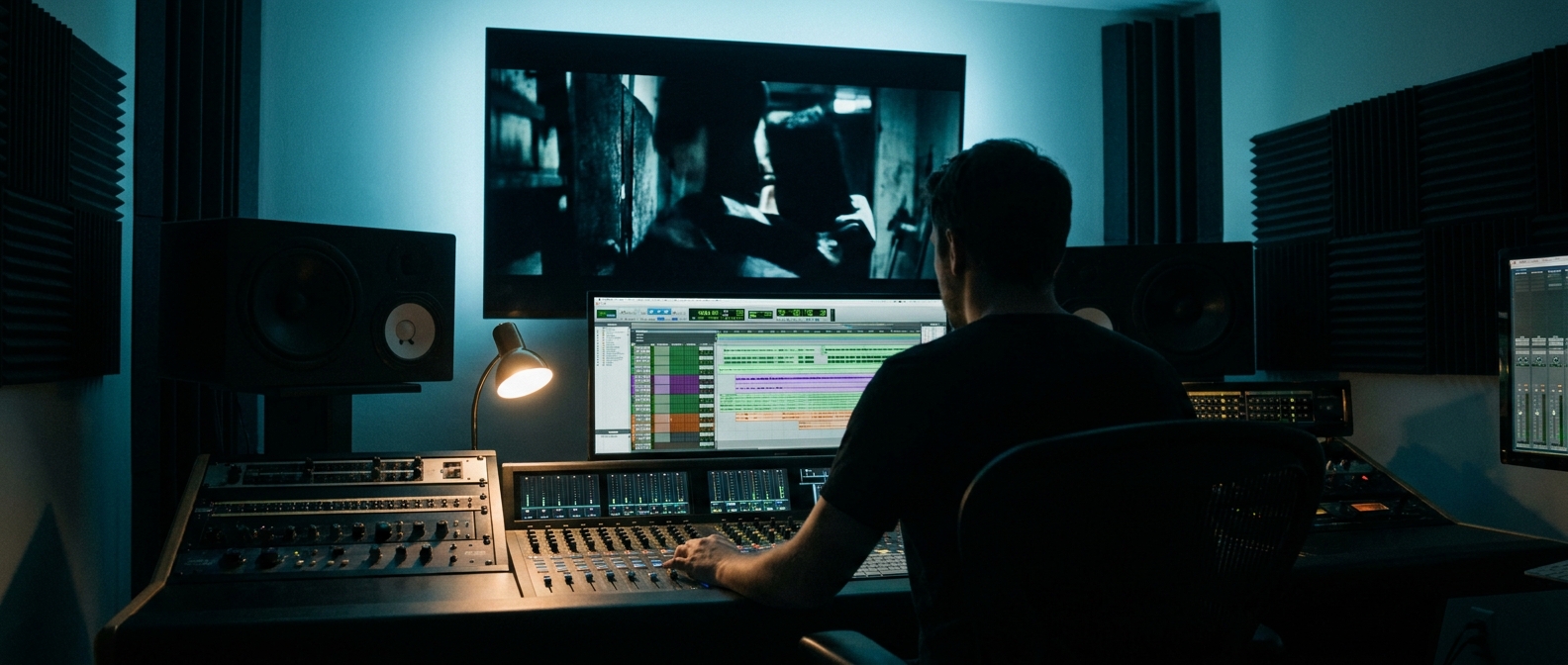
What a trailer cut demands from music
A trailer is not a scene. It is a sales pitch built from a film it is selling, and the music carries most of the persuasion. Where a feature score breathes for two hours, a trailer cue has ninety seconds, sometimes thirty, to set a tone, escalate it, and land a hit on the title card. That compression changes what you need from a track before you ever think about who owns it.
Trailer music for movie trailers tends to move in a structure editors quietly rely on. It opens restrained, often on a single texture or piano. It builds through tiered risers. It breaks once, hard, on the cut that reveals the premise. Then it drives to a final braam or button under the logo. If a cue cannot give the edit those landing points, it does not matter how good it sounds in isolation.
- Clean intro: a low-commitment open the editor can lay narration or a cold line over.
- Tiered build: risers and percussion that escalate in stages, not one flat ramp.
- A hard break: a moment of near-silence or a single hit that frames the reveal.
- A defined button: a braam, stinger, or resolved tag that lands the logo and credits.
The trailer-music chain, and where it stalls
When you go to license music for trailers, you run into a market that splits in two directions, and the split matters for both your budget and your calendar.
Specialist trailer houses
A handful of boutique companies write almost nothing but trailer music: the epic, hybrid-orchestral, all-build cues you recognize from theatrical campaigns. The work is purpose-built and often excellent. The catch is access and terms. Many cues are pitched per campaign, priced against the size of the release, and tangled in exclusivity windows that keep a track off your competitor's trailer but also keep it out of reach until a deal closes.
Production libraries
The other path is a production music library with real cinematic depth. A strong library carries the epic, dramatic, and horror material a trailer leans on, already cleared, already structured for the cut, and available the moment you find it. For teaser content, social cutdowns, indie features, game and app trailers, and the long tail of brand work that needs a trailer feel without a theatrical budget, this is usually the faster and saner route.
Stems for trailer work
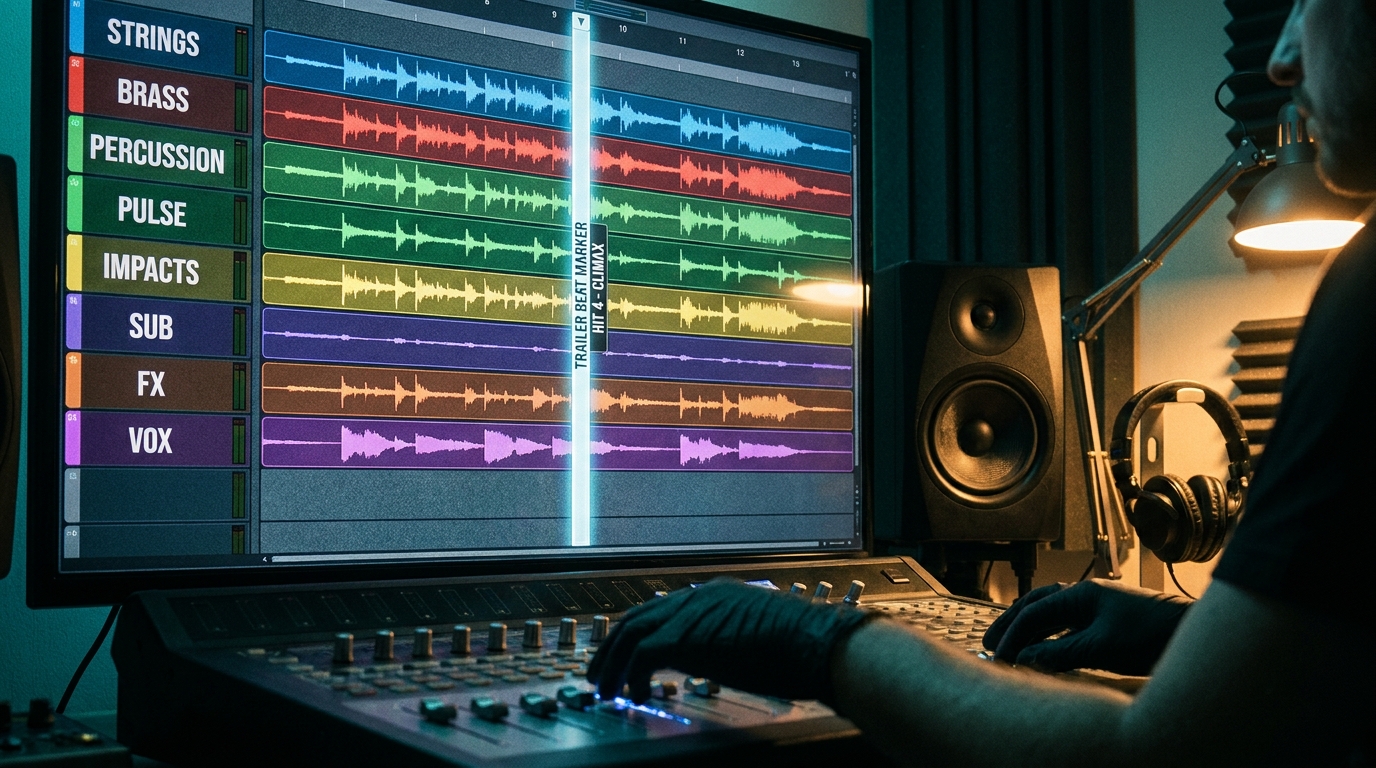
No trailer cue survives the edit untouched. The picture lock shifts, a hit lands two frames early, a producer wants the strings out under the narration. This is the part of trailer licensing where stems stop being a nice-to-have and become the whole job.
With multitrack stems, the editor pulls the drums down for a dialogue beat, swaps the riser to align with the new reveal, and pushes the brass up under the logo without going back to anyone. Without stems, every one of those moves is a request, a wait, and a renegotiation. GMP ships stems standard with every cue, so the trailer can be cut to the music and the music re-cut to the trailer in the same room.
The depth of the trailer section is the other half of this. A teaser that needs a stripped piano version of the cue you used in the launch trailer is usually a different track from the same family in the catalog rather than a re-record of one. With sixty thousand cleared cues organized by intensity, instrumentation, and arrangement, the alternate read of a cue you already love is generally a few filters away.
Clearing theatrical, streamer, and YouTube cuts
A trailer is never one deliverable. It is a family of cuts: the theatrical version on a thousand screens, the streamer placement, the 30 and 15 second YouTube and pre-roll edits, the vertical social versions, and the out-of-home stings on a billboard loop. Each one is a different media context, and on a traditional license, each one can be a different line item.
This is where term-limited, territory-bound deals quietly become expensive. A cue cleared for the theatrical campaign but not the YouTube cut leaves you exposed the moment the trailer goes wide online, which it always does within the hour. The scope you need is broad by default, because trailer distribution is broad by default.
- Theatrical exhibition for the in-cinema trailer.
- Streaming and OTT, including the platform's own trailer rails.
- YouTube, pre-roll, and paid social across every cutdown length.
- Out-of-home and digital signage loops.
- Worldwide territory, because a release rarely respects one country.
GMP's trailer-ready catalog and turnaround
The catalog holds sixty thousand cleared, broadcast-ready tracks, and the slice that matters for trailers is deep: epic builds, dramatic tension, horror textures, hybrid-orchestral risers, and the percussion and braam beds that land a reveal. Every cue is filterable by mood, tempo, and intensity, so a brief like dark, building, ninety seconds, hard hit at sixty returns options you can drop on the timeline immediately.
Pre-built durations are part of why this works on a trailer schedule. Most cues arrive with a 60, a 30, a 15, a stinger, and a loop already cut, which maps almost exactly onto the deliverable family a trailer campaign needs. With stems in the room, the edit room can shape the rest from the multitrack instead of waiting on a new file.
- Search the catalog yourself, or send the brief and the cut and get a curated shortlist back within one business day.
- Audition watermarked WAVs against the trailer, reveal and button in place, until a cue locks.
- Confirm the cue and the use. We issue a flat-rate license with no scope negotiation.
- The full mix, stems, and the 60/30/15/stinger/loop edit set deliver same-day on confirmation.
The result is that the music stops being the part of the trailer you sweat. The clearance is settled at the source, the scope already covers every cut, and the stems are in the room. What is left is the only question that should be left: which cue sells the film.